
Early detection of tau protein deposits, which causes the onset of Alzheimer’s disease, is important for early treatment with anti-tau drugs currently under development. Our research group has successfully developed [18F]SNFT-1 as a candidate compound for a novel PET tracer that is expected to detect tau protein deposits in Alzheimer’s disease patients with high sensitivity. [18F]SNFT-1 showed high-contrast images of early tau pathology in postmortem brain sections and satisfied the pharmacokinetic properties required for PET tracers. [18F]SNFT-1 does not bind to monoamine oxidase B (MAO-B), which has been known as an off-target binding site of tau PET tracers. It also does not bind to protein fibrils other than tau.
We performed in vitro autoradiography of [18F]SNFT-1 using postmortem brain samples from older adults who showed early Alzheimer’s disease pathology despite the absence of dementia symptoms. The results showed that [18F]SNFT-1 clearly delineated tau lesions even in Braak stage II brain sample, corresponding to the early stage of tau pathology (Figure 1).
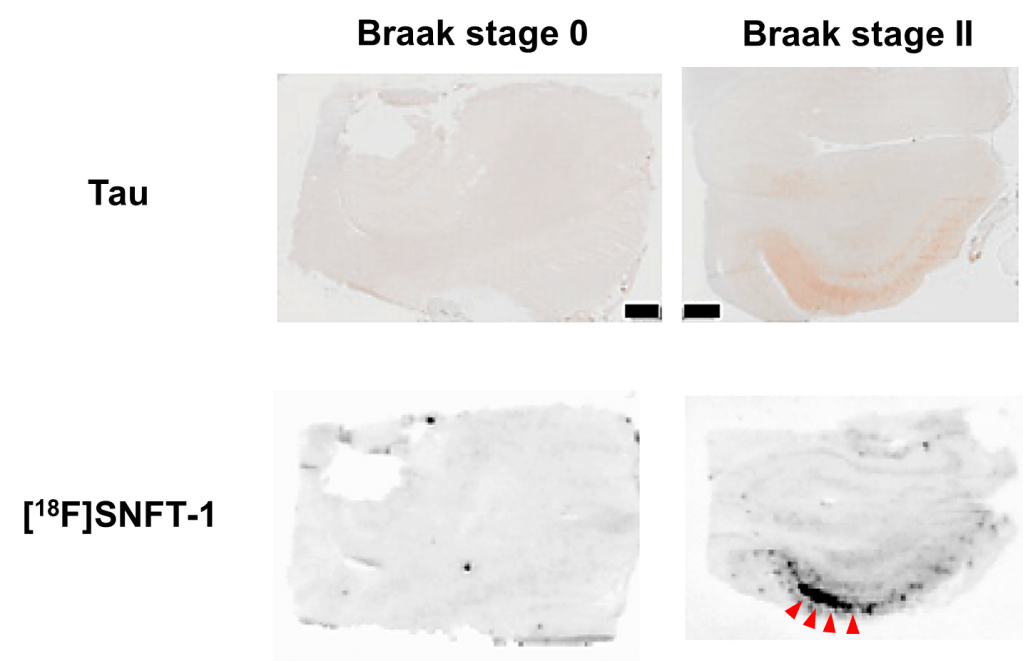
Figure 1. Tau immunohistochemistry and in vitro autoradiogram of [18F]SNFT-1
In the Braak stage 0 brain sample (left), in which no tau deposits are present, no [18F]SNFT-1 binding was observed. In contrast, the Braak stage II brain sample (right), which showed early tau lesions in the transentorhinal region, showed a clear [18F]SNFT-1 binding (red arrowheads) consistent with tau immunohistochemistry.
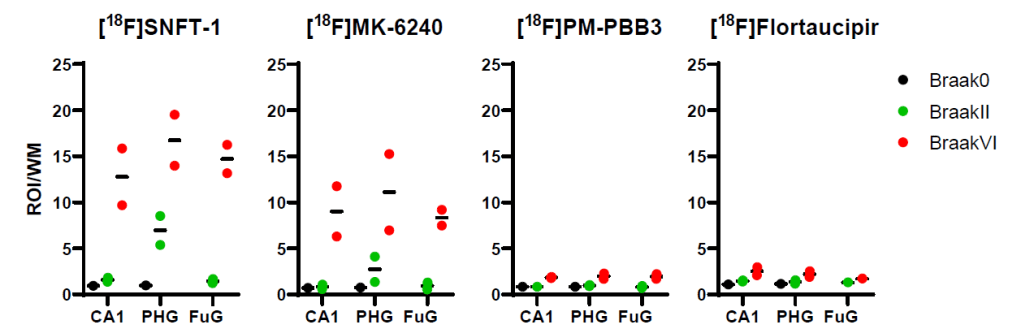
Figure 2. Comparison of the signal intensity of [18F]SNFT-1 with other tau tracers at sites commonly showing early tau deposits (hippocampal CA1, parahippocampal gyrus (PHG), and fusiform gyrus (FuG))
We compared the signal intensity of [18F]SNFT-1 at three locations (CA1, PHG, and FuG) with other existing tau PET tracers (Figure 2). The results showed that [18F]SNFT-1 was able to detect tau deposits in Braak stage II (green) and stage VI (red) with the highest contrast. This suggests that [18F]SNFT-1 may detect tau with higher sensitivity than conventional tau tracers.
Reference
Preclinical Characterization of the Tau PET Tracer [18F]SNFT-1: Comparison of Tau PET Tracers
Ryuichi Harada, Pradith Lerdsirisuk, Yuki Shimizu, Yuka Yokoyama, Yiqing Du, Kaede Kudo, Michinori Ezura, Yoichi Ishikawa, Ren Iwata, Miho Shidahara, Aiko Ishiki, Akio Kikuchi, Yuya Hatano, Tomohiko Ishihara, Osamu Onodera, Yasushi Iwasaki, Mari Yoshida, Yasuyuki Taki, Hiroyuki Arai, Yukitsuka Kudo, Kazuhiko Yanai, Shozo Furumoto and Nobuyuki Okamura
Journal of Nuclear Medicine (2023)
DOI:10.2967/jnumed.123.265593
URL: https://jnm.snmjournals.org/content/early/2023/06/15/jnumed.123.265593
 東北医科薬科大学医学部 薬理学教室